What Professional Credentials and Awards Really Mean in Photography
In photography, titles and awards are often misunderstood. To many people, they sound like marketing language or personal milestones. In reality, professional credentials exist for a very specific reason. They are systems of peer review designed to measure consistency, technical mastery, ethics, and long-term commitment to the craft.
Anyone can create a beautiful image on a good day. Professional credentials ask a harder question: can you do it again, and again, under scrutiny, over years.
This post explains what those credentials actually represent, why they exist, and why they matter when choosing a photographer for something as personal as a portrait of your dog.
The examples referenced here reflect the credentials I have earned and the judging systems I have participated in, not an exhaustive list of all credentials available in photography.
Why professional photography credentials exist
Photography has no licensing board. There is no universal exam that declares someone a professional. Because of that, respected organizations developed voluntary systems to hold photographers to measurable standards.
These systems rely on peer evaluation. Images are judged by experienced photographers, not by algorithms or popularity. Degrees and awards are earned over time, based on bodies of work, service, and repeated evaluation, not by taking a single class or paying a fee.
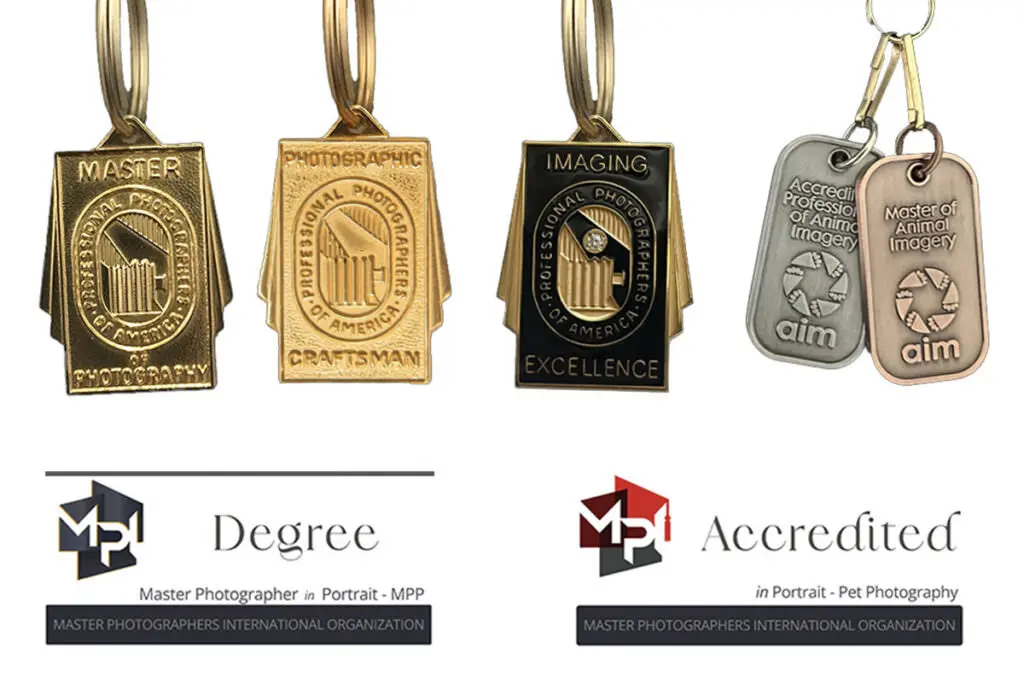
Certified Professional Photographer (CPP)
The Certified Professional Photographer credential, offered through the Professional Photographers of America, is designed to establish a baseline level of technical and professional competence. Earning the certification requires passing a comprehensive technical exam and submitting images that demonstrate consistent control of lighting, exposure, color, and composition.
The CPP is often one of the first formal credentials photographers pursue. It confirms an understanding of photographic fundamentals and professional practices, rather than advanced specialization or artistic distinction.
I earned my CPP over a decade ago, establishing a verified foundation in technical proficiency early in my professional career.
Master of Photography degree (M.Photog.)
The Master of Photography degree, awarded by the Professional Photographers of America, is not a course or a certificate program. It is earned through a combination of image merits and service merits accumulated over many years.
Image merits are awarded through print competition. Each image is judged individually for technical excellence, lighting, composition, impact, and storytelling. Only images that meet a high professional standard earn a merit.
Service merits are earned through ongoing contribution to the profession. Teaching, mentoring, speaking, volunteering, and helping advance photographic education all count toward this degree.
This matters because it demonstrates two things at once. The ability to consistently create strong work, and a long-term commitment to professional standards beyond one’s own business.
I earned this degree in 2020 after several years of print competition and professional service, with work evaluated by national panels of judges.
Photographic Craftsman degree (Cr. Photog.)
The Photographic Craftsman degree focuses on education and service. It recognizes photographers who actively contribute to the growth of the profession through teaching, mentoring, writing, or leadership.
This degree signals that a photographer is trusted by their peers not just to create work, but to help define what good work looks like. It reflects depth of experience, generosity with knowledge, and accountability within the professional community.
I earned this degree in 2023 through sustained teaching, workshops, and speaking engagements for PPA affiliates and other professional photography organizations over a three year period.
Master of Animal Imagery
Animal photography requires more than technical skill. Subjects cannot be directed, conditions are unpredictable, and the photographer is responsible for the animal’s safety and emotional well being throughout the process.
The Accredited Professional of Animal Imagery and Master of Animal Imagery credentials, awarded by Animal Image Makers, are earned through a progressive system. Photographers must first demonstrate foundational proficiency through merited image scores and professional evaluation before advancing to the master level, which recognizes sustained excellence, education, and contribution to the animal photography community.
These credentials are earned through a combination of merited animal imagery submissions, continued education, professional speaking, and participation within the organization, including the AIM conference. Together, they reflect both artistic quality and ethical practice.
I earned the Accredited Professional of Animal Imagery designation during its inaugural year, one of only 9 photographers internationally to do so, and became one of the first 12 to earn the Master of Animal Imagery credential as part of that progression.
Master Photographer in Portrait (MPP)
This year also marked another meaningful milestone in my professional journey. I was awarded the Master Photographer in Portrait designation through the Master Photographers International (MPI) Degree Program.
It is earned by consistently producing images that meet rigorous judging standards over time, while demonstrating technical skill, creativity, and artistic consistency. The program requires photographers to accumulate qualifying achievements through the International Imaging Competition and complete additional accreditation requirements before the Master designation is awarded.
How professional print competitions are judged
In most professional print competitions, images are judged against a defined standard rather than against each other. Each image is evaluated individually on criteria such as lighting, technical execution, composition, emotional impact, and storytelling. Scores are deliberate, and judges are required to articulate why an image meets or does not meet merit level.
This merit based approach has long been the foundation of professional photographic competitions, including the International Photographic Competition for many years. Medals were historically earned when an image met a high professional standard, regardless of how other entries performed.
In recent years, some competitions have shifted to head to head formats, where images compete directly against one another and only a single entry in each category can receive top recognition. While this approach reflects judging preference rather than individual scoring, many professional organizations and competitions continue to evaluate images based on independent merit and defined standards.
Understanding this distinction matters, because merit based systems reward consistency and craftsmanship across bodies of work, not just a single favored image.

Recognition across multiple organizations
Recognition across multiple professional organizations carries particular weight because each competition operates independently, with different judging panels, scoring systems, and standards.
When work is recognized repeatedly across organizations such as Professional Photographers of America, Master Photographers International, Texas Professional Photographers Association, and animal-focused organizations including Animal Image Makers and International Society of Animal Photographers, it indicates consistency rather than a single standout result.
Independent juries arriving at similar conclusions over time is often more meaningful than any individual award.
A full list of awards and recognitions can be found HERE.
What makes an award-winning image
Award-winning does not mean flashy or dramatic. More often, it reflects an image that is intentional. One that tells a story, evokes emotion, and expresses creativity, while still meeting rigorous standards for lighting, posing, technical execution, and composition.
An award-winning image feels intentional rather than forced. The lighting supports the subject instead of overpowering it. The moment feels honest. In animal portraiture, it often reflects patience, respect, and a deep read of behavior rather than control.
These qualities are rarely accidental.
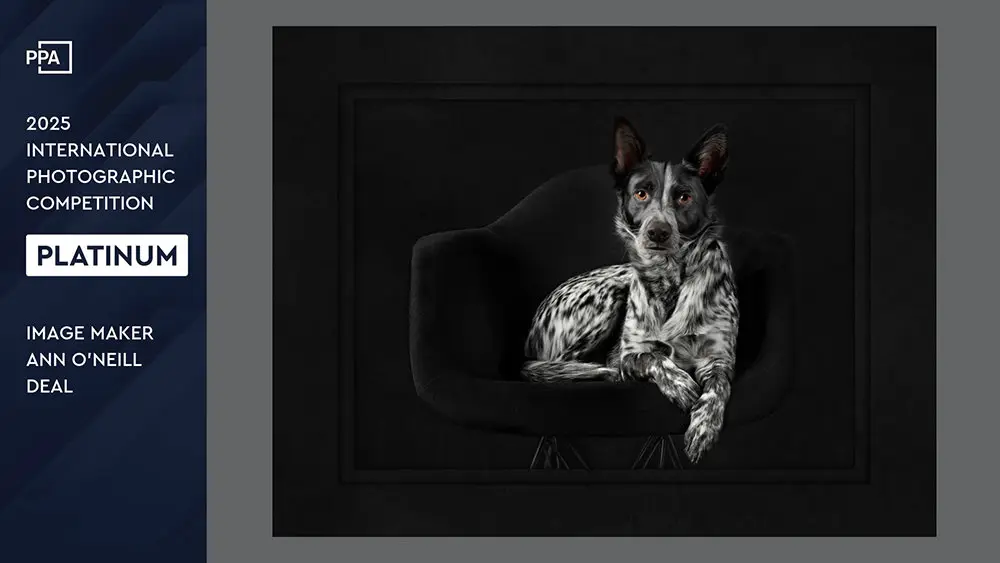
Platinum medal (second place) image from PPA’s International Print Competition 2025
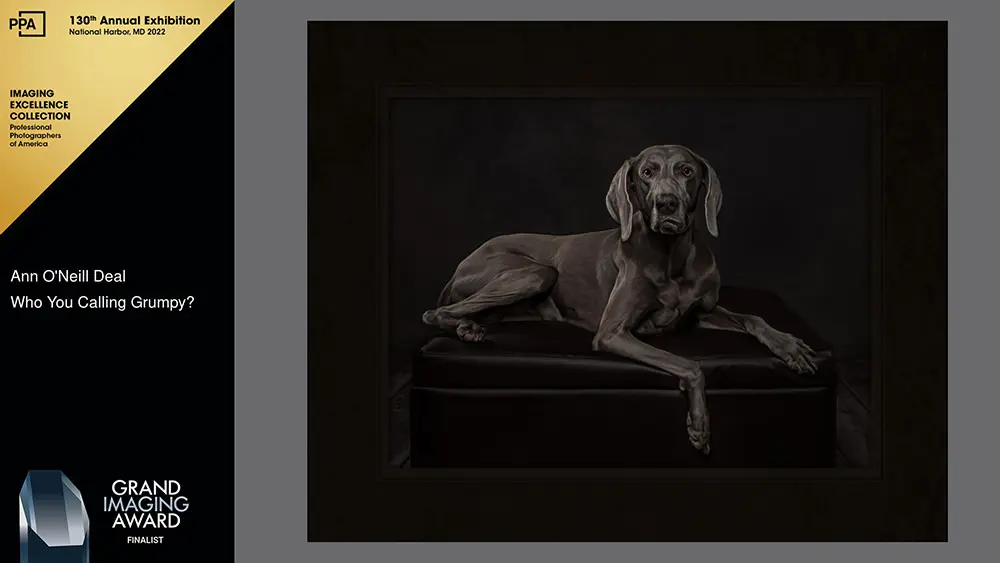
Imaging Excellence and Grand Imaging Award finalist image and part of a four image Diamond Medalist Case from PPA’s International Print Competition 2022
Why this matters when choosing a photographer
Credentials and awards are not about prestige. They are about reliability. They are evidence of experience. They reflect time spent making decisions under scrutiny, adapting when conditions were not ideal, and meeting professional standards and technical excellence time and time again when expectations were high.
When a moment cannot be repeated, that experience matters.